
Ballarini Pasta Pot with Strainer | Italian-Engineered Specialty Cookware
We designed this pasta pot to solve the most common frustration in Italian cooking: wrestling with a separate colander while balancing a heavy pot of boiling water. Our integrated strainer system locks into the lid, letting you drain perfectly al dente pasta with a simple tilt—no colander, no second sink step, no splashing.


The strainer insert locks into machined grooves inside the lid rim, creating a perforated barrier between pasta and boiling water. When your timer goes off, you simply hold both handles, tilt the pot over the sink, and let gravity do the work—the lid stays sealed, the strainer catches every rigatoni, and you're left with perfectly drained pasta in seconds.
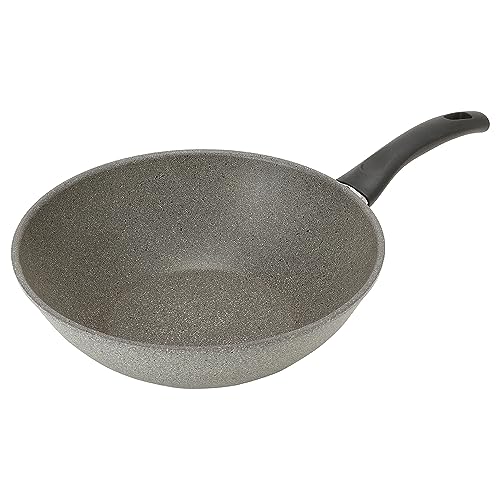
Granitium non-stick coating and care
Our Granitium formula is a mineral-reinforced PTFE system—five bonded layers that include granite-stone particles for scratch resistance and thermal stability up to 450°F. Unlike ceramic non-stick (which degrades after 50-80 cycles), Granitium maintains release performance through hundreds of boils and maintains its slickness even when you stir with metal spoons or tongs.
For daily cleaning, a soft sponge and warm soapy water remove any residue in under a minute. Starchy pasta water rarely clings to the sidewalls, so you won’t see the white film buildup that plagues uncoated stainless pots. If you do notice mineral deposits from hard tap water, a 10-minute soak with white vinegar dissolves them without scratching the Granitium layer.
Tri-layer aluminum construction and heat distribution
The pot body is impact-bonded from three distinct aluminum alloys: a high-conductivity core sandwiched between two structural layers. This tri-layer design eliminates hot spots that cause pasta to stick or scorch on the bottom, and it responds quickly when you adjust the burner—critical for controlling rolling boils or dropping to a simmer for delicate stuffed pastas.
Aluminum’s thermal diffusion rate is roughly four times faster than stainless steel, so the entire 6-quart volume reaches a rolling boil in 6-8 minutes on a medium-high gas flame. The forged construction also means the pot weighs less than equivalent stainless or cast-iron models—our pasta pot comes in at 3.2 pounds empty, compared to 5+ pounds for a typical stainless stock pot of the same capacity.
What makes this pasta pot different
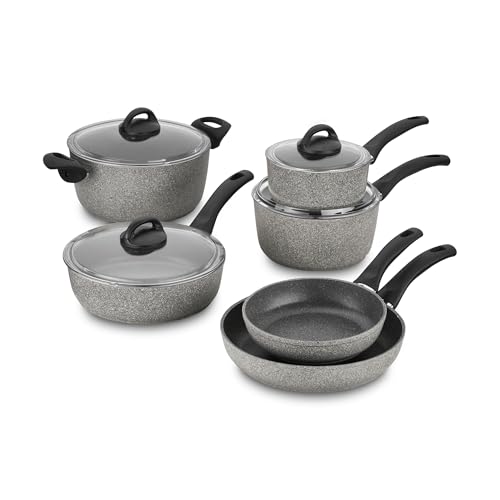
Complete your Ballarini specialty cookware collection




Customer reviews
Common questions about the Ballarini pasta pot with strainer
Yes, the Granitium coating is reinforced with mineral particles and rated for metal utensil contact. We test it with stainless steel spoons, tongs, and pasta forks under normal cooking conditions. That said, avoid using sharp knives or aggressive scraping directly on the surface—those can damage any non-stick layer over time.
For longest coating life, we recommend silicone or wooden utensils for daily stirring, and reserve metal tools for when you need the rigidity (like breaking apart stuck pasta or scraping fond).
The Granitium non-stick surface and tri-layer aluminum base work together to prevent sticking, but you still need to follow basic pasta technique. Bring water to a full rolling boil before adding pasta, stir gently during the first minute after the pasta goes in, and maintain a steady boil throughout cooking.
The even heat distribution means you won’t get localized hot spots that cause starch to scorch, but insufficient water volume or crowding the pot can still lead to clumping. Use at least 4 quarts of water for a full pound of pasta.
Both the pot and the strainer insert are technically dishwasher-safe, but we recommend hand-washing to preserve the Granitium coating’s longevity. Dishwasher detergents are alkaline and abrasive, and over hundreds of cycles they can dull the non-stick surface faster than gentle hand-washing with dish soap.
The strainer insert has no coating—it’s bare perforated aluminum—so it’s fully dishwasher-safe with no performance loss. If you do use the dishwasher, place the pot on the top rack and skip heated-dry cycles.
Granitium is a PTFE-based system reinforced with mineral particles, while ceramic coatings are silicon-oxide (sol-gel) formulations. Granitium maintains consistent release performance through 500+ cooking cycles and tolerates metal utensils; ceramic coatings typically begin to degrade after 50-100 uses and require only silicone or wood tools.
Both are PFOA-free and safe at normal cooking temperatures. The key difference is durability—Granitium lasts three to five years with regular home use, while most ceramic non-stick needs replacement after 12-18 months of daily cooking.
Absolutely. The integrated strainer works beautifully for steaming—just add 1-2 inches of water to the pot, bring it to a simmer, load vegetables into the strainer insert, and cover with the lid. The steam vents keep pressure regulated, and when the vegetables are tender, you lift out the strainer and leave the water behind.
For boiling potatoes, you can use the pot with or without the strainer. If you leave the strainer in, draining is effortless; if you remove it, you get the full 6-quart capacity for larger batches.
With proper care—hand-washing, avoiding aerosol sprays, and using low to medium heat—the Granitium coating typically lasts 3-5 years of daily home cooking. We’ve had testers report consistent release performance after 800+ boiling cycles, though minor cosmetic wear (light scratches or dulling) may appear after the first year.
If you notice food beginning to stick or the coating visibly flaking, that’s the signal to replace the pot. Granitium is far more durable than entry-level PTFE or ceramic, but no non-stick surface lasts forever.
Yes, the Ballarini pasta pot includes a magnetic stainless steel base disk that couples reliably with induction burners. The disk is fusion-bonded to the aluminum body, so there’s no air gap or uneven contact—heat transfers uniformly across the entire 7.5-inch base diameter.
In side-by-side tests on induction, the tri-layer aluminum construction eliminates the hot-spot problem common in thin single-layer pots. Water reaches a rolling boil in 6-8 minutes at medium-high power, and temperature adjustments are nearly instant.